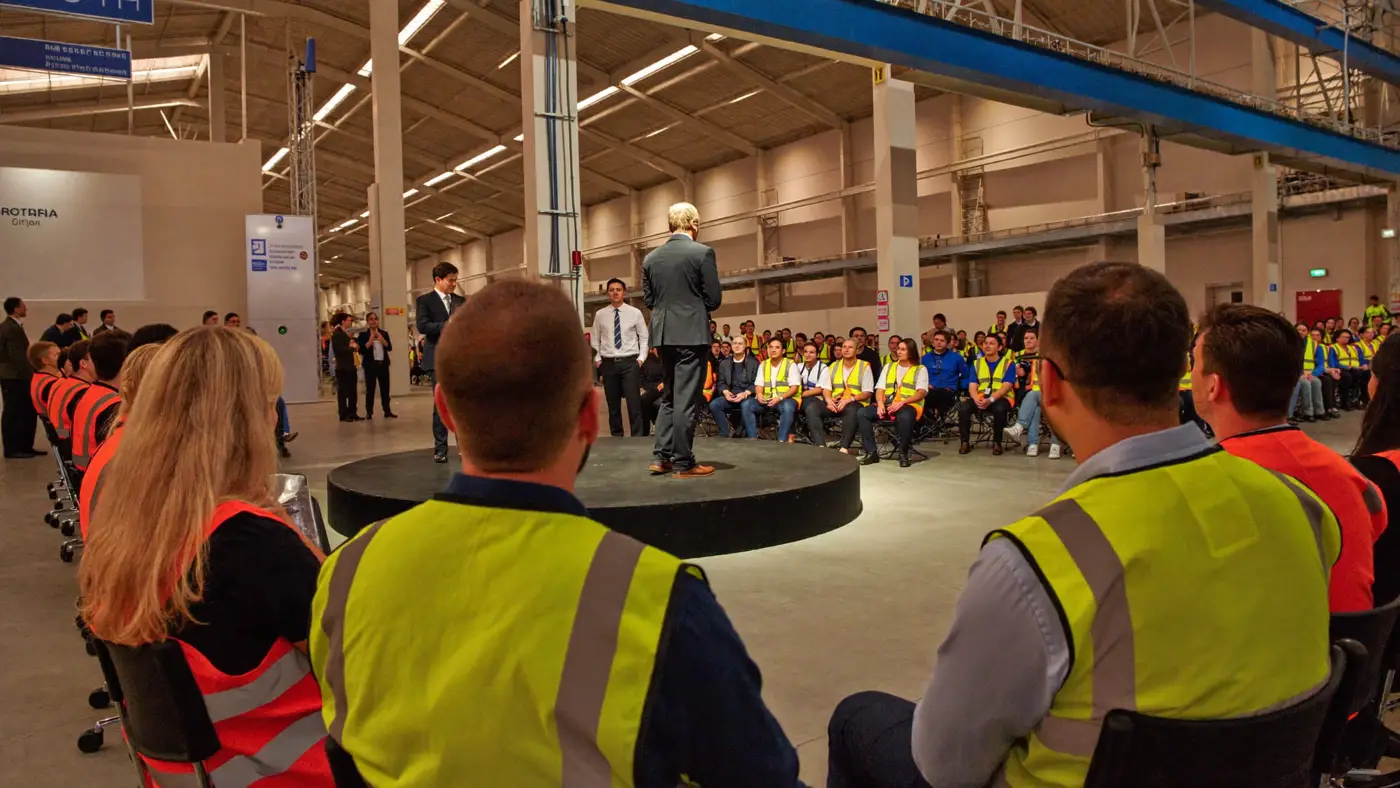



Most internal communications are written for people who sit at a laptop, and most employees do not. The machine operator on the second shift, the driver on a delivery route, the nurse, the store manager, the field technician in another country: they do not read the all-staff email that went out at 4pm. They hear about it from a supervisor, a group chat or a rumour in the canteen, and by then the message has changed.
Quiamo is an internal communications agency for companies whose people are spread across offices, plants, warehouses, stores and languages. We help chief executives, chief people officers and internal communications teams make sure that important news reaches everyone, is understood the way it was meant, and can be acted on by Monday morning.
What an internal communications agency should fix first
Before we produce anything, we find out how information actually moves through your organisation. Not how the org chart says it moves. We interview leaders, managers and frontline employees, look at the last few big announcements and trace where each one went, where it stalled and how it was retold.
The result is a short audit that answers practical questions. Which groups are reliably missed? Which managers are trusted sources and which are bottlenecks? Which channels are read, and which are merely sent? What language does each site work in, day to day? In most organisations one or two groups reliably hear the news last, and they are often the people closest to customers.
Employee communications for office, shop floor and frontline
Different audiences need different formats, and pretending otherwise is the most common failure in employee communications. We plan for each group separately:
- Office and knowledge workers, who have email and the intranet but are drowning in both. They need fewer, sharper messages with a clear “what this means for you”.
- Shop floor and plant teams, who get news at shift briefings, on notice boards and on screens near the line. They need short, visual material a supervisor can explain in five minutes.
- Frontline and field staff in stores, vehicles and customer sites, who rely on their phones and their managers. They need mobile-first messages and a manager who has been briefed first.
- Leaders and managers, who are both an audience and a channel. They need the reasoning behind a decision, not only the decision.
Multilingual workforces, written by native speakers
A global message translated word for word rarely lands. Idioms break, tone shifts and a sentence that sounds warm in English can sound cold or even alarming in another language. For multilingual workforces, our local-language work is done by native-speaking colleagues and specialists who adapt the meaning as well as the words, and who check it with a manager on the ground before it goes out.
We also plan the order. If a change affects a plant in one country and a sales office in another, both should hear it on the same day, in their own language, from someone they recognise. That sounds obvious. It is also where many announcements go wrong.
Manager cascades that survive the retelling
Most people would rather hear important news from their own manager than from an email. That makes the manager cascade the most important channel you have, and often the weakest, because managers are handed a forty-slide deck at short notice and asked to “cascade” it.
A manager toolkit from us is built for the person who has to stand in front of a team. It usually contains:
- A one-page briefing: what is happening, why, and what it means for this team.
- A five-minute talk track in plain language, with the key message in the first sentence.
- The ten questions employees are most likely to ask, with honest answers, including “we do not know yet”.
- A short visual or poster for the team area, where relevant.
- A simple way to send questions and concerns back up, so leadership hears what the floor is saying.
We brief managers before their teams, ideally in a short live session, so they understand the decision well enough to explain it in their own words.
When your last big announcement reached the night shift, what did they hear?
Let us trace itTown halls, intranet and newsletters
A town hall is the rare moment when the whole company listens to its leaders at once. We help plan the running order, write the remarks, design slides people can read on a phone, prepare leaders for the difficult questions and make a short recording and summary for everyone who could not attend live. Our leadership communications team works closely with CEOs so their voice at a town hall matches the voice they use everywhere else.
For everyday channels we look at the intranet, the newsletter, digital screens and messaging apps as one system. Each gets a job. The intranet is the library and the source of truth. The newsletter is the weekly story. Screens and posters carry the one thing everyone on site needs to know this week. Clear jobs mean fewer messages and higher attention. Where the intranet itself needs work, our web design team can help with structure and design.
Change communications: new systems, restructuring and acquisitions
Change communications is where internal communications earns its keep. Three situations come up again and again.
New systems. An ERP, a new HR platform, a new way of logging production. People resist systems they do not understand, so we explain the why before the how, build training material around real tasks and plan communication for the weeks before, during and after go-live.
Restructuring. Reorganisations, relocations and role changes are handled with your HR and legal teams, who decide what can be shared and when. Our job is to make sure people hear it clearly, respectfully and from the right person, and that the people who stay understand what happens next.
Acquisitions. Two companies, two cultures and two sets of rumours. We plan day one messages for both workforces, the first hundred days of communication and the introduction of new leaders, closely aligned with the external story from our corporate communications team.
Measuring understanding, beyond open rates
An email open tells you that a message was seen for a second. It tells you nothing about whether anyone understood it or will act on it. We measure what matters:
- Short pulse questions after key announcements, asking people to choose the correct summary of what changed.
- Feedback from managers after each cascade: what questions came up and where confusion remains.
- Question volumes to HR and helpdesks before and after a change, as a sign of clarity or confusion.
- A simple test for leaders: can five people from different sites explain the change in one sentence?
These measures are cheap to run and far more useful than a dashboard of clicks. They tell you where to go back and explain again.
We report them to you in a short note after each major announcement, with the two or three places where understanding is weakest and a suggestion for fixing each one. Sometimes the fix is a second, simpler message. Sometimes it is a better-briefed manager, a poster in a second language or a five-minute video from the plant head. Over a year, the pattern of those notes becomes the most honest picture you have of how well your organisation actually talks to itself, and it shows your board that internal communications is managed with the same care as any other operational function.
Employee engagement communications that people believe
Engagement is not created by posters about values. It grows when employees understand where the company is going, see their part in it and trust that leadership tells them the truth. Communication supports that by being consistent, timely and honest, including about bad news. When the brand strategy changes, employees should be the first to hear it, and they should hear it in words they would use themselves.
Much of our founder’s career has been spent in companies with plants, field teams and several languages, which is why our manufacturing and industrial work treats the shop floor as a first audience, not an afterthought. We work remotely, over video, with internal teams worldwide, on a fixed fee explained on how we charge.
Often paired with this work: employer branding and change communications.